
Sex Offender Checks in La Salle County
The Texas Public Sex Offender Registry is the primary public channel for a La Salle County sex offender check. Texas DPS manages the statewide data, while local law enforcement receives registrations, verifies required information, and sends updates to DPS. The La Salle County Sheriff is the local contact when a record appears wrong, a person may not be complying, or a resident needs to ask where registration work takes place. The sheriff can be reached at 101 Courthouse Square in Cotulla or at (830) 879-3044.
Use the state search for Texas records and the federal search when a location sits near a jurisdiction line. Neither tool is a general criminal-history system. A person may have a criminal case without a public registration duty, and a public registry entry reflects only the information Chapter 62 and DPS policy permit. Search results may also lag a recent move or local update. Match several profile fields, then contact DPS or the sheriff instead of drawing a conclusion from one name or one map point.
La Salle County Registry Contact
La Salle County’s sheriff acts as the local law-enforcement authority for registration and verification. The official county material does not publish a separate registration counter, appointment schedule, or document checklist. Call first and ask for the sex-offender registration officer. Confirm the place, time, identification, papers, and reporting schedule before traveling to Cotulla. This direct contact is also the right local path for suspected noncompliance. Call 911 only for an emergency.
The sheriff’s role is distinct from DPS’s role. Local staff handle required contacts and statutory notices; DPS maintains the public registry. That split matters when a search result needs review. A technical portal problem or state profile correction belongs with DPS. A question about where a La Salle County registrant reports, or a report of apparent local noncompliance, starts with the sheriff. Public sources do not support a claim that La Salle County offers its own separate list, map, or alert system.
Note: Confirm the La Salle County registration counter and hours by phone because the official county pages do not publish those details.
How to Search the Texas Public Sex Offender Registry
Begin with the DPS conditions of use and choose the route that fits the facts already known. A name search works best with exact spelling and more than one identifier. A geographic search can use an address, city, county, or ZIP code. The interface may also offer higher-education searches. A map is a way to inspect reported locations, not proof that no other person with a registration duty is nearby.
- Read and accept the DPS notice, then choose a name, address, or other available search route.
- Enter the narrowest reliable details. Select La Salle as the county, or use Cotulla, Encinal, an address, or a ZIP code.
- Compare the result list with photographs, aliases, physical traits, and other identifiers. Do not rely on a name alone.
- Open the full profile and read the offense, jurisdiction, address, compliance status, risk level, and registration dates as separate facts.
| Field Label | Type | Required | Notes |
|---|---|---|---|
| Last Name | Text | Route-dependent | Use exact spelling first; the portal controls broad matching. |
| First Name | Text | Optional | Helps narrow common last names. |
| Address | Text | Geographic route | Street number and street name are required on the expanded form. |
| City / County / ZIP | Text or select | Optional | Choose La Salle County or enter a local place. |
| Birth Date | Date | No | Available on the name route; first and last name are required there. |
| Institute / Campus | Select | Education route | The campus list depends on the chosen institution. |
The official DPS search screen shown here illustrates why the route and fields matter.
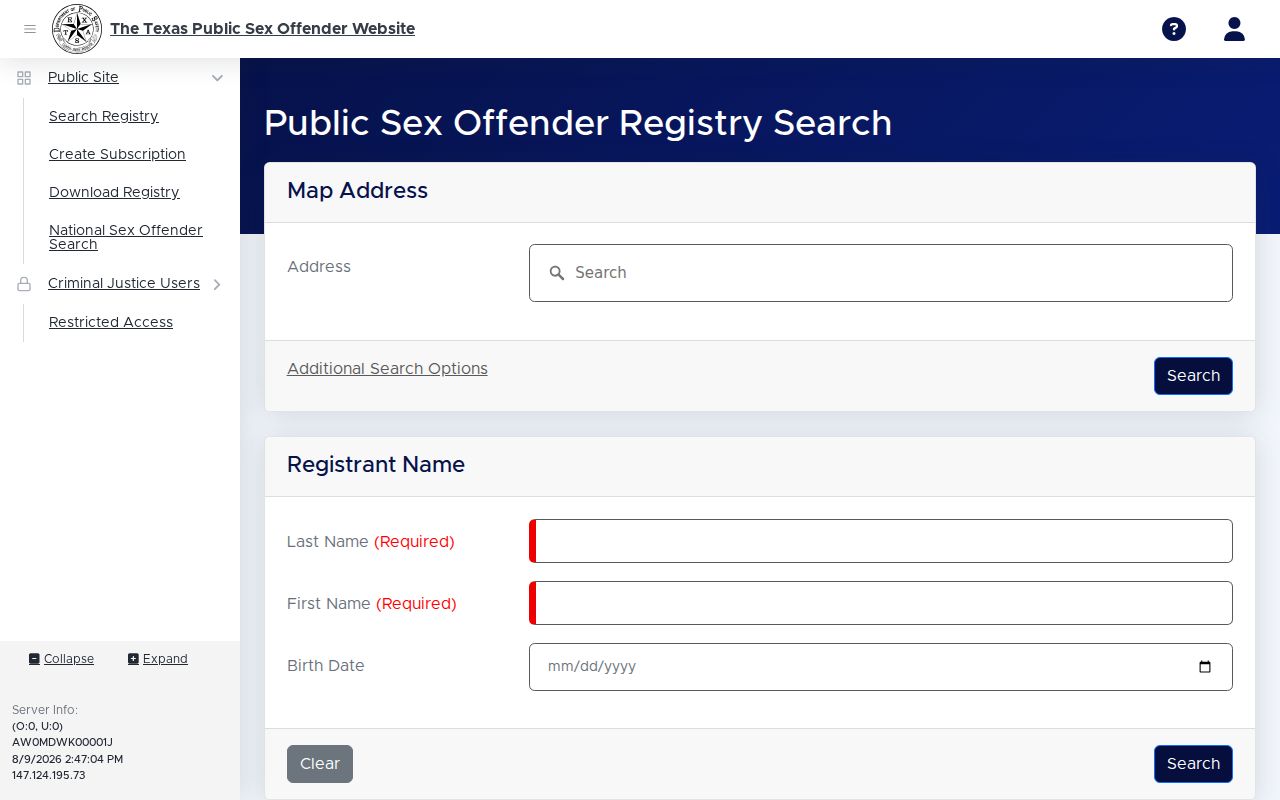
The screen is the starting point for a public check, while the profile and local confirmation supply the context needed to read a match.
La Salle County Registry Searches Near Borders
La Salle County covers a broad rural area, and an address search can sit close enough to a county boundary that one state result list gives an incomplete view of the surrounding area. Repeat a geographic check with nearby places and use the National Sex Offender Public Website when cross-jurisdiction coverage matters. NSOPW draws from participating official registries, so it adds range without replacing the Texas source.
The national search interface provides that second layer without centering the search on a private profile.
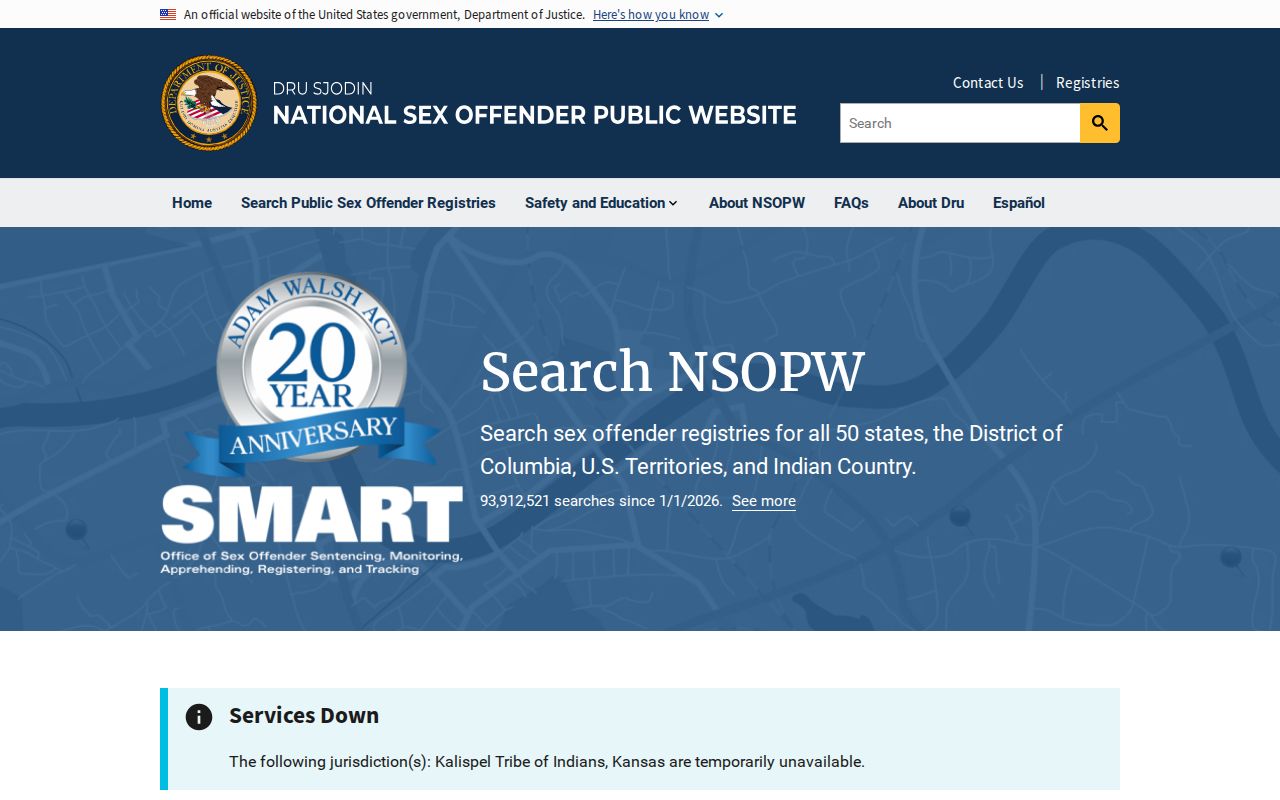
Compare any national result with the originating state record because the state registry remains the best source for its own status fields and notices.
A blank map area is not a safety guarantee. Not every offense creates a public registration duty, some information may be delayed, and statutory rules can limit what appears. Use the tools as one part of a practical safety plan. If a record seems stale or a listed address raises a compliance concern, report it to the agency rather than visiting the location.
Inside a Registry Profile
A public DPS profile can combine identity, location, offense, and registration facts. Exact display depends on Texas Code of Criminal Procedure Chapter 62 and DPS policy. The fields should be read together. A photo may help distinguish two people with similar names, while aliases and physical marks add more checks. Offense and court data explain the legal basis of the entry. Status and verification dates speak to registration, not whether a person has committed a new offense.
| Name & Aliases | Public name forms and other names associated with the registration record. |
|---|---|
| Photo & Description | Current or other photographs plus public sex, race, height, weight, hair, eyes, scars, marks, or tattoos. |
| Registered Address | The public residence or other location information allowed by law and DPS policy. |
| Offense & Court | Offense, statute, conviction or adjudication date, court, and jurisdiction, with victim categories where authorized. |
| Risk Level | Texas screening-tool assessment of danger to the community, separate from registration duration. |
| Registration Status | Compliance, registration start, verification information, reporting agency, and other public status details. |
Vehicle or institution information may also appear when public under the governing rules. Do not turn those fields into a reason to contact, follow, or confront anyone. If two key facts conflict, save the profile reference and ask DPS or the La Salle County Sheriff to review it.
La Salle County Registry Risk and Duration
Texas risk level and registration duration answer different questions. Levels 1, 2, and 3 describe a screening-tool assessment from low through serious danger to the community. They are not the federal SORNA tiers and do not set the end date by themselves. Article 62.101 instead ties duration to the offense and other statutory facts. Civil commitment is another distinct status, not a synonym for level 3.
This distinction prevents a common reading error. A lower numeric risk level does not by itself mean a short duty. Likewise, a long registration term does not automatically establish the highest risk level. Read the offense-specific statute and the profile’s registration fields before drawing a conclusion.
Note: Texas risk levels describe assessed danger, while Article 62.101 and related provisions control the length of registration.
Texas Registration Levels and Requirements
Texas Code of Criminal Procedure Chapter 62 governs reportable offenses, public information, notices, verification, changes, and registration duration. Article 62.101 generally assigns lifetime registration to enumerated offenses. Other qualifying adult convictions generally carry a period that ends ten years after release from confinement or discharge from community supervision, whichever statutory calculation is later. Juvenile and special provisions can change the result.
| Classification | Meaning or Duration | Verification |
|---|---|---|
| Risk Level 1 | Low danger assessment; not a duration tier | Frequency depends on statutory classification and status |
| Risk Level 2 | Moderate danger assessment; not a duration tier | Frequency depends on statutory classification and status |
| Risk Level 3 | Serious danger assessment; not a duration tier | Frequency depends on statutory classification and status |
| Lifetime Duty | Applies to offenses enumerated by Article 62.101 | Use the offense-specific rule and current profile |
| Ten-Year Duty | Generally calculated after release or discharge for other reportable adult convictions | Use the offense-specific rule and current profile |
The official Chapter 62 text shown here is the source to consult when profile shorthand is not enough.
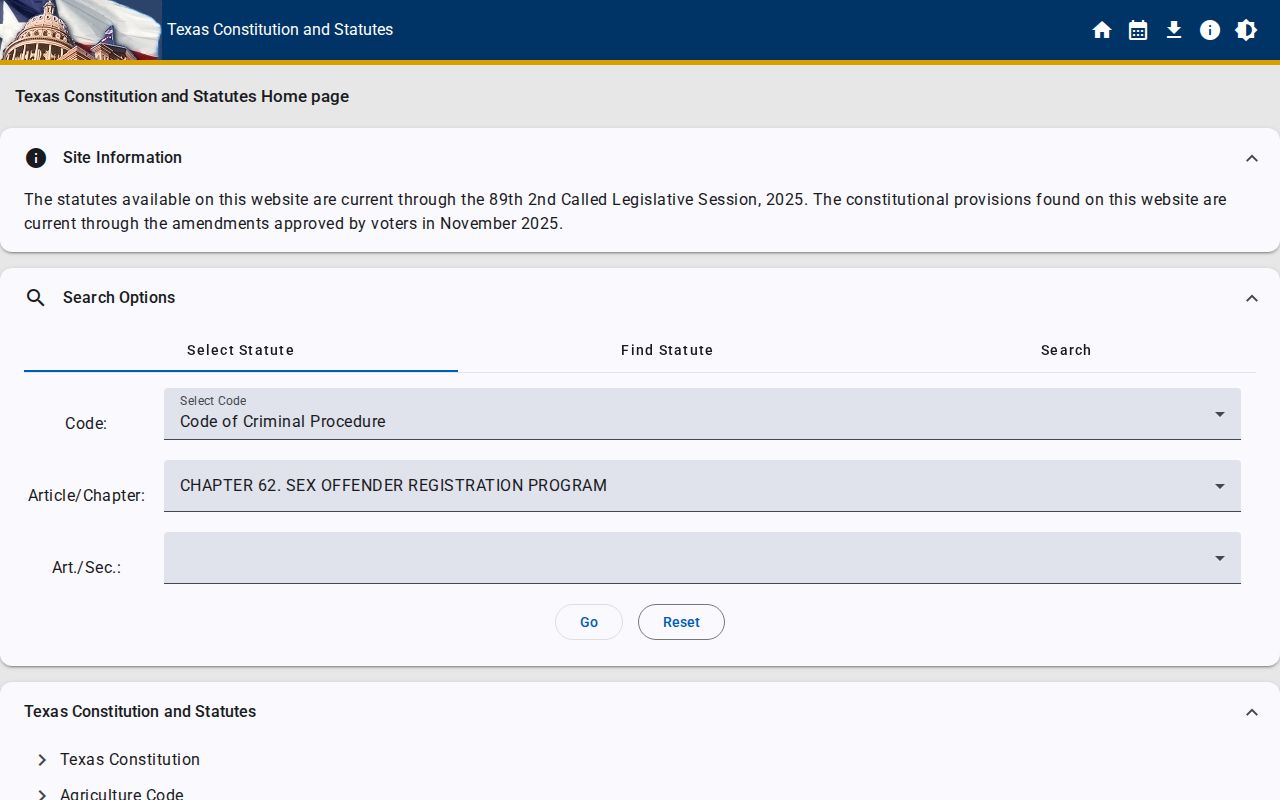
The statute also shows why a single three-level chart cannot state every reporting schedule or end date accurately.
Correcting La Salle County Registry Information
When a profile appears to show the wrong address, status, photograph, or identity details, do not try to resolve it with the listed person. Record the official profile reference and the field that seems wrong. Contact DPS for a registry-data or portal issue. Contact the La Salle County Sheriff at (830) 879-3044 when the issue concerns local registration, a reported location, or apparent noncompliance.
Give the agency precise facts without publishing them elsewhere. A current page URL, the field at issue, the date seen, and the reason it appears inconsistent are more useful than a broad allegation. For an urgent threat, call 911. For a nonurgent question, use the normal agency channel and allow staff to check restricted information that is not visible to the public.
La Salle County Registry Community Notices
Texas community notification depends on risk, status, and Chapter 62 procedures. Local law enforcement may have duties involving specified people or locations and newspaper or postcard methods where the statute calls for them. DPS controls the statewide public registry. La Salle County does not publish a separate online notification signup or local registry map in the official sources reviewed, so residents should not assume that a missing alert means no registration exists.
Registry information is meant for awareness and safety planning. It can help a family review a neighborhood or help residents understand an official community notice. It does not authorize private enforcement. Report a suspected breach through law enforcement and let the agency assess the facts.
Community Notification and Lawful Use
DPS notices and Chapter 62 set limits around registry information. Use public details to make lawful safety choices and to understand official notices. Do not use a public listing to threaten, injure, shame, trespass, stalk, discriminate against, or harass a registrant or anyone in the household. A registry entry also does not establish that a person has committed a new crime.
Misuse can be a crime: Texas Code of Criminal Procedure Chapter 62 and DPS warnings do not permit harassment, threats, injury, vigilantism, or unauthorized release of restricted registration information. Misuse may lead to criminal or civil consequences.
Contact the sheriff about an apparent local compliance issue. Contact DPS about the statewide entry. That approach protects public safety, preserves evidence, and keeps the matter with officials who can review both public and restricted facts.
Note: A registry search supports community awareness, but it cannot prove that every person who may pose a risk appears in the results.